HUMANITY SCREAMING
Michael Tuckson
Introduction
Introduction
Humanity
Screaming

It’s the underbelly of humanity that is screaming: our poor upbringing and education, our ignorance, our misjudgements, our lies and arrogance. We need to step back to think more carefully about our thinking, our existence. In addressing the fundamentals of our existence, should we rejoice in such comforts that we do have and try to ignore any perils, or first examine the weaknesses in our basic thinking. I will suggest the latter. At the risk of reverberating shocks, I will claim that the most basic problems facing humanity are not war, fire, floods and starvation, but the limited compassion and poverty of reason and empirical belief in everyday thought. An explanation requires a reason and empirical belief or empiricism which is based on evidence. If we were to think more carefully and analytically about these tragedies, wondering more about their causes rather
than starting only with the immediate symptoms, we might progress further. Certainly, immediate catastrophes can overwhelm us, but once we have learned to live with the change we should revert to basic thinking. Our weak sense of reason and empiricism stems from our poor education which is part of our overall system, our humanity system. So long as we do not understand the ideas of liberal philosophers who 200 years ago championed freedom and equality, as well as logico-empirical analysis, and a positive humanism, we are doomed to unseemly conflict.
The starkest example of the poverty of reason and empiricism is religion that besets every major country. Most religions, are sets of largely non-logico-empirical beliefs about the supernatural mainly held dogmatically, originally associated with ethnic communities a thousand or more years ago. While they support peoples’ lives, they have been, and along with material inequality, continue to be a contributor to misinformation and conflict, along with the growth of hierarchy, adverse personalities and other factors.
Buddhism is the main exception. It emerged possibly about 5500 years ago south of the Himalayas in parallel with Hinduism at the time of the earliest text, the Rig Veda. It first spread to Sri Lanka and Southeast Asia, called Hinayana, engendering limited feeling, and in Mahayana a more compassionate form, but badly translated, to China and Japan. It has hardly caused conflict. An early relatively benign Indian king became Buddhist. Various Hindu kings ruled much of India often more violently, one expanding his rule into Southeast Asia. Hindus follow a range of gods such Shiva and Vishnu. Buddha rejected belief in
Fueling Minds, Forging Futures
We deliver relentless academic support designed for ambitious learners who refuse to settle.
Our methods merge data, discipline, and drive to create results that stick long after graduation. Learn More
Early conviviality led on to disputes and the establishment of the government-state of Israel which soon fell into conflict with Muslim Gazans, soon attacking them without mercy. Israel, along with quasi-Christian USA, began attacking Islamic Iran while Iran and Iranian proxies attacked Israel.

These Afghan girls will not be allowed to study at school above the primary level.
Further east, Muslims in Pakistan are in conflict with Muslims in Afghanistan and Hindus in India. Quite distinctly, Wahhabism, a fairly new militant Muslim ideology, which is known as Islamist, evolved in the Arabian desert and was spread to previously fairly moderate Islamic Indonesia.
Roman emperor Constantine in 200s -300s CE used Jesusism that had morphed into Christianity to vastly expand his empire eastward, notably discriminating against Jews, a trend that was continued and exacerbated by Christians in Europe until after the Holocaust.
In the USA since the 1900s, Jews have built undue power while an assortment of Christian faiths contest chaotically and atheism rises. In Northern Ireland conflict between Catholics and Protestants has at times fallen into civil war. Some groups of Catholic teachers in private schools are known to have long abused their young male charges.

gods even as many of his followers treat him as a god. Here we can see in Buddha, evidence of reason and empirical thought. Violence has taken place in some Buddhist parts of Southeast Asia, but this has been mainly due to colonialism.
Jews follow an ancient Hebrew belief that grew from their migration northwest from Sumer to the Levant some 4000 years ago. They derived the concept of one god from the city Ur’s god in Sumer. About 900 CE while in the Levant as slaves, they also developed secular ideas that they hold in parallel with the religious beliefs, just as scientists that hold Christian beliefs have later done. The Jews were liberated by Cyrus II of Persia, a secular king, surely an event worth commemorating. The Jews have since migrated to several destinations, but many have returned to Gaza in the Levant.
Some 2000 years ago a Jew named Jesus, who led a separate small movement known by some as Jesusism, claimed godly status and preached compassion.
Religious people often misunderstand cause and effect. Reason and empiricism can easily be lost. For example, although clearly Joseph was Jesus’s father, Christians believe their god was.
In the 600s, Mohammad, after many violent tribulations, drawing on some of Jesus’s ideas, established Islam in Arabia. The new religion spread across Southwest Asia, including Gaza, and North Africa to Spain. Having suffered earlier from Alexander’s invasion, the moderate culture of Persia was overrun by Islamic Arab forces. Persia was partly recovering when it was overrun again, this time by religiously tolerant Mongols who thus left Islam in place. The returning Jews thus foundGaza populated by Muslim Arabs.
Follow for Daily Knowledge Hits
⦁
Follow for Daily Knowledge Hits
Follow for Daily Knowledge Hits ⦁ Follow for Daily Knowledge Hits
Religion, however is not the only source of problems. Government-state is usually subservient to mega-corporations and the armed forces including the private media, exercising dominance over the people. Notable exceptions include Scandinavia. Powerful government-states aggressively expand their influence abroad leading to colonialism and ultimately globalization. Nevertheless, we can note that like Emperor Constantine, several European countries later used the Christian Church to help spread their colonial power.
The power-force of government-state and industry involves the invasion of indigenous land, large scale mining, the destruction of landscapes, worker exploitation, poverty and pollution. Data centres are now spreading using massive amounts of resources, but are at last facing popular opposition. The coal and oil industry, its off-shoots, the auto-industry and other fossil-fuel based industries create massive emissions of carbon dioxide that are jeopardizing real ecosystems and the human future. The people can protest, but labour unions must strike to help stop them.


Eco-humanism is the best positive, logico-evidential alternative to religion. One of the early Popes was a humanist. Humanism is the belief that humans are central to their own more or less positive life without a god. The humanity system, a term coined in 2014, is a useful way to integrate all ideas about human life. Partly using genetic and cultural inheritance, adverse personalities self-select to try to obtain wealth and power-force to dominate others. In any large-scale humanity system, it is needs and wants, together with personalities, mental capacity and system conditions, that drive actions and activities. Individual thoughts and conditions depend in turn on the history of the total system.
Much science is a devious idea. Take astronomers who study ever more obscure micro-particles emanating from distant sources, while failing to engage us in dialogue about the massive waste of money that requires, but more importantly closer to Earth the waste and atmospheric pollution due to satellite launches and orbits.
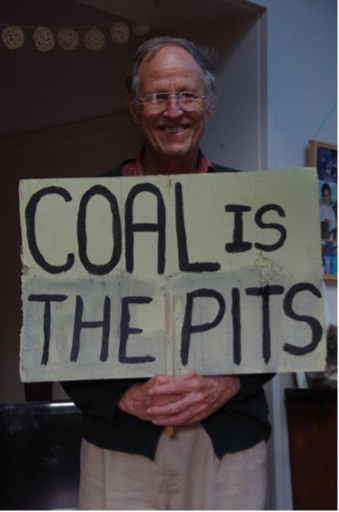


The author preparing for a protest
Conclusion
To humanity screaming
Clearly, we need to consider our thinking, our existence more carefully. The most basic problems facing humanity are the limited compassion and poverty of reason and empirical belief in everyday thought. We should think more carefully and analytically about these tragedies, wondering more about their causes and effects. The starkest example of the poverty of reason and empiricism is religion that besets every major country.
5500years ago Buddhism became the main exception. Later Jews derived the concept of one god from the city Ur’s god in Sumer. They also developed secular ideas that they hold in parallel with the religious beliefs. Some 2000 years ago a Jew named Jesus, who led a separate small movement known by some as Jesusism, claimed godly status and preached compassion. Religious people such as Christians often misunderstand cause and effect.
In the 600s, Mohammad, established Islam in Arabia. The new religion spread widely. Jews later established Israel in Gaza and now they violently oppress the Muslims in there. Along with quasi-Christian USA, they began attacking Islamic Iran. Since Constantine, Christians have discriminated against Jews, a trend that was continued and exacerbated by Christians in Europe. On the other hand, In the USA since the 1900s, Jews have built undue power while an assortment of Christian faiths contest chaotically and atheism rises.
Eco-humanism is the best positive, logico-evidential alternative to religion.Humanism is the belief that humans are central to their own more or less positive life without a god.
Government-state is usually subservient to mega-corporations and the armed forces including the private media. Fossil-fuel based industries create massive emissions of carbon dioxide that are jeopardizing real ecosystems and the human future. The people can protest, but labour unions must strike to help stop them.
IS LEARNING WORTHWHILE
Schooling, Education, Learning or Understanding?
What an absurd question you say. Surely everyone wants to learn, but around what remains of the habitable globe, it must be assumed, some are either frustrated or confused by what they meet in the contemporary classroom, if indeed they have a classroom. But the majority still lie improbably under a conformist spell. Presumably some want to learn, even though they might ask themselves what should we learn; and even, is learning worthwhile, and if it is then how are we to learn, to understand, to know, both as individuals and collectively? Most may surely reply, we go to school! But I will, of course, challenge that easy answer.
Our problems in the first place are partly related to poor quality schooling, which for the contemporary modernizing world, grew with industrialization and spread with colonialism. This is not to mention the contemporary environmental horrors which are not wholly natural, but at least partly, if not wholly human caused. In schooling, I include all primary and high school experiences, colleges and university, as well as odd courses on the side, but other factors may intrude. At secondary and tertiary school, you may be offered standard subjects such as mathematics, history and economics. Some will say we should read outside books, while increasingly, at least, youth will hold up their i-phone, or could we say their dependency phone, their mobile communication and fun screen, vastly overused, and dangerous, especially for the young brain.
We should at least be cognizant of the huge limitations of schooling. One possibility is to put greater effort into the extra-curricular opportunities. Family and community may offer chances that could be taken up. My boyhood family included artists, an art administrator, an auto engineer, a senior businessman and cooks (housewives), but although of course I chatted regularly with them, the idea of serious learning for me was only addressed concerning car repairs. The school once introduced the idea of family links to learning when my father was invited to address our high school class about painting. In many regions, it could be possible to integrate learning opportunities between families in communities.
Better schooling depends of course on having people able to facilitate and even implement it. The world could benefit from less compulsive schooling and more integrated schooling curricula together with strengthening of public radio, the establishment of public television services, and more informal or non-institutional education and community leadership on ‘social media’.
By the age of fourteen I had become especially interested in India by reading a book borrowed from the local library, and but for the dreary geography teacher this would have been my favorite subject. Geography was both ‘physical’ and human. However, the apparent bias of our national system during the ‘cold war’ between the communist Soviet Union and the capitalist ‘West’, due to specialization, together with the measly understanding that my elders had of schooling and education, led me into physical science at secondary school and university without a query. Thus, I found myself with only a limited knowledge of the human and even the biological world around me.
Entering Sydney University molded firmly as a science student, we were given the choice of geology or biology as a fourth subject. We were offered no consultation on the curriculum options. Subjects such as philosophy, anthropology, psychology and even geography only came to mind later due to university diversity. And while studying geology, I eventually managed to get to India on a back-packing trip.
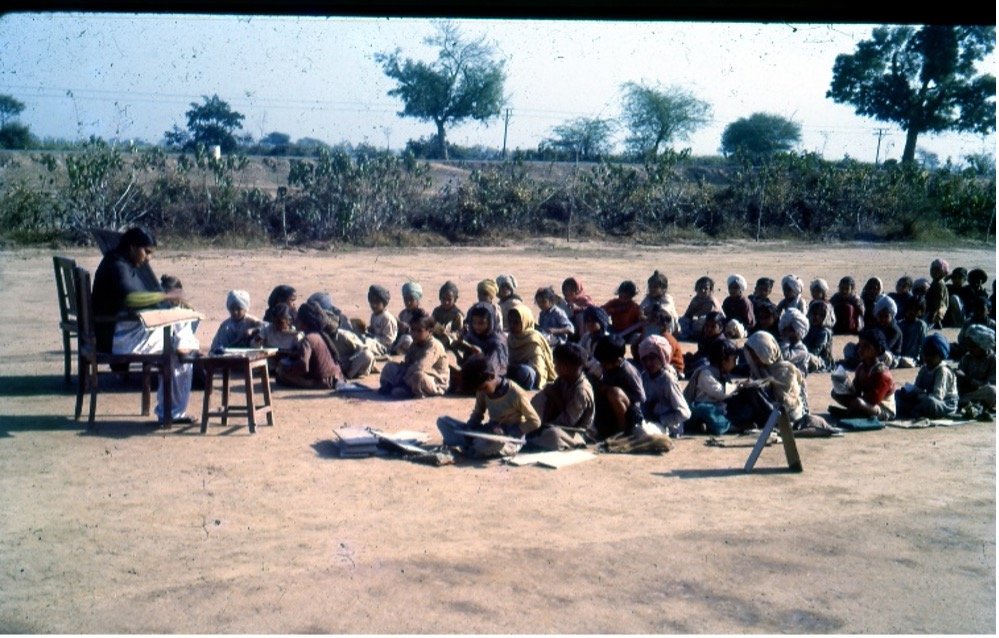
Figure……..The pupils and teacher at a school at Basant Pura near Chandigarh in the Punjab, India in 1965 clearly could be experiencing exposure to the weather, limited technology and a high pupil-teacher ratio, but one could still ask whether the teaching method and the subjects taught are more important issues.
Devising new approaches to support student learning will require much creativity. Surely along with improvements in teaching methods, a more holistic curriculum, having a fully integrated course alongside specialized courses, would give children a better understanding of themselves, their family and friends, wider local systems, their nation, larger regions and the world. In an integrated view, they would be studying what I have called ‘humanity systems’. It would also enable them to better choose further subjects to study, and one or more careers. With students more or less educated by schooling, book reading, better led mass media and social media, we might be able to better solve our multitude of problems.
The better alternative to economics, sociology, and other disciplines, is humanity systems theory that encompasses all the social sciences, history, philosophy, as well as physical structures, technology and the natural environment related to humans that I first outlined in my 2014 MAHB blog, still often online in 2026 We can invite economists to see beyond money, to imagine at least the local region, or other area, holistically.
So clearly learning is worthwhile, but the details need analysis. We need to consider community conditions and needs, the relevance of integration,
My 2014 self-published book Changing the world outlines the theory of the Humanity System. Very limited copies are available for AUD20 by emailing me at mtuckson@runbox.com